
What makes IVF clinic marketing different from other clinic marketing?
Three things separate fertility from every other specialty a marketer touches. First, the research cycle is long and deep. An IVF decision is emotionally loaded, expensive, and usually made after months of reading — comparing processes, eligibility criteria, lab standards, and logistics across multiple clinics. The clinic whose content actually answers those questions earns trust cycles before the first inquiry arrives. Thin service pages and ad campaigns don't survive that scrutiny; a deep content asset does.
Second, the compliance ceiling is lower. The default playbook of aesthetic marketing — patient stories, dramatic outcomes — is precisely what fertility regulation restricts hardest, most sharply under Australia's AHPRA rules. What remains permitted everywhere is the thing fertility patients want most anyway: clear, evidence-led answers.
Third, the patient pool is genuinely international. Most small clinics are told "international patients" as a fantasy; in IVF it is a documented segment. Cross-border fertility care reaches private clinics directly — patients compare countries the way other patients compare suburbs. That changes what your website needs to be: not a local brochure, but a multilingual asset that answers questions in the language the patient researches in.
Where do IVF patients actually come from — in Australia, the US, and the UK?
The engine is the same everywhere — content that gets found and cited, response in the patient's language, settlement in your CRM — but the mix of patient lines differs by market. These are the three plays we design audits around.
Australia — the strongest inbound story
- Australia's inbound medical travel market (≈USD 445M in 2025, per industry research estimates) counts IVF and fertility among its leading categories — drawing patients from Southeast Asia, Chinese-speaking markets, and the Pacific
- Sydney and Melbourne's large Chinese-speaking communities are a domestic line addressable in their own language, on their own messengers
- Every page written to AHPRA's 2025 advertising guidelines — no patient testimonials, no outcome claims
US — cash-pay depth plus cross-border intended parents
- Fertility is heavily cash-pay and self-pay — which is also what keeps the fee model clean: no federal-program business in the base
- International intended parents arrive through egg-donation and surrogacy pathways — researching in Chinese, Spanish, and Japanese long before they email
- Domestic patients in your metro are already asking ChatGPT and Google's AI Overviews which fertility clinic to trust — AI-search visibility wins them first
UK — self-pay research, AI-assisted
- Private fertility treatment is a self-pay decision researched exhaustively — the same deep-content approach that wins AI citations wins these readers
- London's international patient base — 100,000+ overseas patients treated a year across the self-pay market — includes patients comparing fertility options in their own language
- Content produced with GMC and ASA/CAP standards in mind — no promised outcomes, no promised rankings
One honest caveat, because this page would rather under-promise: inbound volume varies by city, reputation, and service mix, and no agency controls it. What the audit gives you is a measured read — what patients in each language are actually searching for around your clinic and your market, before anything is signed.
Why does AI search matter more for fertility than almost any specialty?
Because the longer and more sensitive the research, the more of it moves into conversational search. Questions patients hesitate to type into a search box — eligibility after repeated attempts, age cutoffs, donor logistics, costs across countries — are exactly what they ask ChatGPT, Gemini, and Perplexity in private. Industry analysts expect traditional search volume to fall roughly 25% as this shifts; in fertility, the shift is amplified by the intimacy of the questions.
AI assistants answer those questions by citing pages that answer them well: structured, specific, evidence-led, schema-marked. That is a content-engineering problem, and it is measurable — we track citations across four AI engines daily, alongside classic rankings for 2,050 keywords, on dashboards you see live during the call. The same pages do double duty: they win the AI citation for the patient in your city and the organic ranking for the intended parent researching from abroad. One engine, both patient lines — domestic patients build the base, international patients add the upside.
How do you market an Australian IVF clinic under AHPRA's 2025 rules?
Australia's regulator prohibits testimonials in health advertising — statements about the clinical aspects of care — and its 2025 guidelines (in force since September 2025) tightened the regime further, with penalties of AUD 60,000 for individuals and AUD 120,000 for bodies corporate. For fertility clinics this is uniquely disruptive: the emotional patient journey story is the genre the entire fertility marketing industry was built on, and it is the genre most clearly off the table.
The compliant playbook is the one we run everywhere anyway: evidence-led answer content. Pages that explain processes, eligibility, timelines, and logistics precisely; comparison and data pages AI engines can cite; multilingual versions for the Chinese-speaking communities of Sydney and Melbourne and the Southeast Asian inbound line. Nothing in that stack depends on a testimonial or an outcome claim — so nothing in it is exposed to the fine. Every page is written to the 2025 guidelines and you approve it before it goes live, because the professional responsibility for advertising sits with the practitioner. For the broader compliance picture, see AHPRA-compliant clinic marketing — this page's sibling for Australian clinics.
What does a multilingual patient line look like in practice?
A patient line is a language-defined channel we build and operate end to end: content assets in that language, search and AI visibility for its queries, and 24/7 response on the messenger that audience actually uses — WhatsApp, LINE, or WeChat. A Chinese-speaking intended parent in Melbourne, or one researching Australian clinics from Southeast Asia, moves through the same line: finds the Mandarin-language answer page, asks a question on the messenger she already has installed, gets a same-hour reply, books.
We run five language lines in-house — English, Traditional Chinese, Simplified Chinese, Japanese, and Spanish — across 7,700+ operated pages. This is the machinery behind the phrase "patient lines you assign": in the audit we map which languages have real search demand around your clinic, you choose which lines to assign to us, and the 20% applies only to collected revenue in those lines. Lines you keep for yourself, and everything your existing marketing produces, stay outside the base — the model is multilingual patient acquisition, not an exclusivity grab.
What does this cost an IVF clinic?
The full model, published: $0 upfront — our fee is 20% of revenue from the patient lines you assign to us, CRM-verified, with no per-patient counting. Typical healthcare marketing retainers run $3,000–8,000 a month regardless of results; we charge nothing until revenue materializes in your CRM. Content production, domains, hosting, rank and AI-citation tracking, and the 24/7 multilingual response line are funded by us — the only pass-through is international press placement, billed at exactly what the outlet charges.
The exact base is designed around your practice during the free audit, before anything is signed: which lines you assign (domestic, international, or both), what counts as new revenue, and what is excluded automatically — existing patients, channels you run yourself, and (for US clinics) any federal-program business; the model covers cash-pay and self-pay services only. And one clarification worth stating plainly for a specialty with a broker-heavy history: this is not a payment for sending patients. We never count, steer, or broker individual patients — the 20% is a flat marketing-services rate on a revenue pool we are responsible for growing. Have your healthcare attorney review the agreement; we expect it.
Four structural terms always travel with the 20%: $0 upfront · non-exclusive · cancel anytime · monthly CRM settlement. Settlement is one monthly export from your own CRM — nothing to audit, nothing to dispute.
| Term | How it works for a fertility clinic |
|---|---|
| Rate | 20% flat — the rate never moves with volume |
| Base | Collected revenue from the patient lines you assign — designed with you during the free audit |
| Verification | Your CRM — one monthly export, no per-patient counting |
| Upfront cost | $0 — no retainer, no setup fee, content and tracking funded by us |
| Exclusivity | None — keep your current agency, run your own campaigns |
| Cancellation | Anytime — no lock-in, no termination fee |
What has this engine done before? Two documented cases
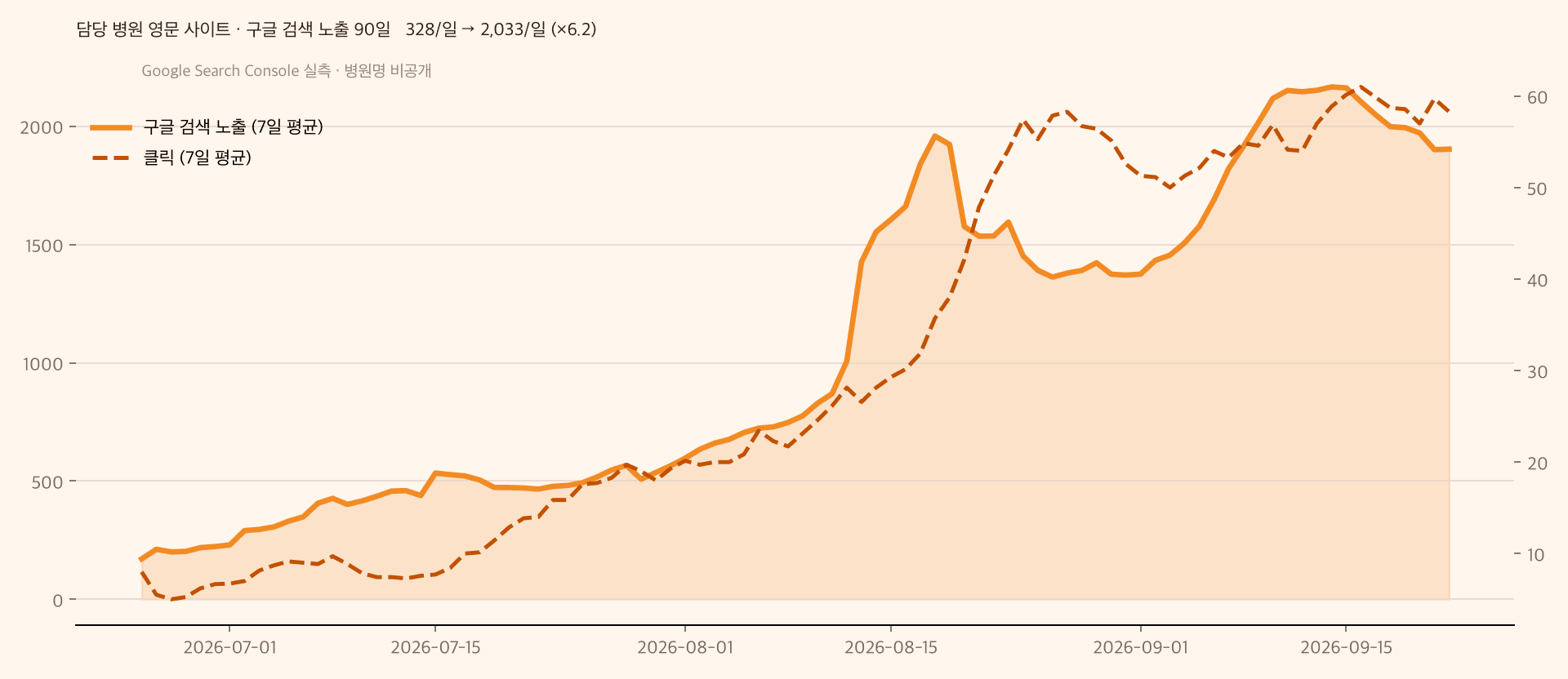
Our documented cases are Seoul dermatology clinics — and Seoul is the point. It is the world's most competitive medical tourism market, two million international patients a year, medical marketing fought in five languages at once. The machinery that ranked and got cited there — multilingual answer content, AI-citation engineering, messenger-native response, CRM-settled fees — is specialty-independent; what changes for fertility is the content, which is what the audit adapts. Both cases, measured the same way:
What should an IVF clinic ask any marketing partner?
Fertility's broker-heavy history makes due diligence non-negotiable — ask these of us and of everyone else. First: are you paid per patient? Per-case payment is the broker model, with the incentive problems and regulatory exposure that follow it; a flat rate on a CRM-verified revenue pool is a different structure, and the difference is the whole point. Second: is the content compliant in my market — AHPRA 2025 in Australia, GMC and ASA/CAP in the UK, FTC endorsement rules in the US — and who reviews it before publication?
Third: which languages, and can you staff them? A translated brochure is not a patient line; ask who answers the WeChat message at 2 a.m. Fourth: show me the tracking live — rankings and AI citations on a dashboard during the sales call, not a PDF after signing. Fifth: what happens when I stop — lock-ins, termination fees, and who keeps the assets. Sixth: how is the fee verified — the vendor's analytics, or my own CRM?
Our answers are on this page, and checking them costs nothing: the free AI-visibility audit shows where your clinic appears today across Google, ChatGPT, and Gemini — in English and in the languages your market researches in — before anything is signed.
'/%3E%3C/svg%3E)