
What is a no-retainer marketing agency?
A no-retainer marketing agency charges nothing per month to exist in your budget. Instead of selling a block of hours and a report, it prices itself against outcomes: in our case, a flat 20% of collected revenue from the patient lines you assign to us, verified in your own CRM, with no per-patient counting. No results in a given month means a zero invoice in that month — the delivery risk sits with the agency, which is where an owner should want it.
That is a different thing from "cheap." The model only works for an agency that builds assets that keep producing — content that ranks, pages that AI engines cite, response systems that convert — because activity alone would bankrupt it. If you want the mechanics of the model itself, the performance-based healthcare marketing page walks through it end to end; if you want to see how the numbers compare to the market, the agency cost benchmarks page publishes the rates most vendors keep behind a sales call. This page is about something more specific: you are in a retainer now, it is not working, and you want out without breaking anything.
What does a locked-in year actually cost?
Run the ledger on the contract you may already be in. Healthcare retainers for a single-location practice commonly run $3,000–8,000 a month, billed on the first, results or not. Take the midpoint as an illustration — not a quote, just the published mid-range:
| Twelve months, side by side | Retainer at $4,500/mo (illustrative mid-range) | No-retainer, 20% of results |
|---|---|---|
| Months where nothing new arrives | $4,500 each, invoiced anyway | $0 — the invoice scales to zero |
| Cash out before any result exists | $13,500 by the end of the first quarter | $0 upfront — production funded by the agency |
| Twelve-month worst case | $54,000 with nothing to show | $0 — the worst case is a free audit and some pages |
| Twelve-month best case | Same $54,000 — the fee ignores the upside too | The fee grows only as your collected revenue does |
| Who carries the delivery risk | You | The agency |
| Exit terms | Often 12-month terms with notice periods | Cancel anytime — no lock-in, no termination fee |
The point of the table is not that a retainer is always the wrong buy — a strong agency on a retainer can be worth every dollar. The point is the asymmetry: in a retainer, the months that fail cost exactly as much as the months that work. An owner seven months into a flat twelve has already paid for the failure; the only question left is how to stop paying for it twice — once in fees, and again in the visibility lost during a badly managed exit.
What should you check before you cancel anything?
Most of the damage in agency breakups happens here, not in the cancellation itself. Retainer contracts frequently leave critical assets in the vendor's name, and clinics discover it only after access is gone. Before giving notice, get written answers to five ownership questions:
| Asset | The question to ask, in writing | Why it matters on exit day |
|---|---|---|
| Domain & website | Is the domain registered to the clinic, and who controls the hosting account? | If the agency registered it, your entire web presence can go dark at term end |
| Content | Does the contract assign ownership of produced pages, photos, and copy to the clinic? | Content the vendor owns can be unpublished — and the rankings it earned go with it |
| Google Business Profile | Who holds primary owner access — the clinic or an agency account? | Losing GBP access means losing your map presence, reviews, and edit rights at once |
| Ad accounts & pixels | Are the ad accounts and conversion pixels in the clinic's name? | Agency-owned accounts take your campaign history and audience data with them |
| Tracking numbers | Do the phone numbers on your listings belong to the agency's call-tracking system? | Numbers that leave with the vendor turn every listing they appear on into a dead end |
If two or more answers come back wrong, do not cancel yet — negotiate the transfers first, while the vendor still wants something from you. This checklist is also a useful filter for whatever you sign next: our own answer is that coverage, links, and the visibility they earn stay with your clinic, and we ask for exactly two links in return — your Google Business Profile website field and one link from your site to the multilingual hub we operate for you.
How do you switch without a visibility gap?
The mistake is treating the switch as a jump: cancel first, then go shopping. That creates a dead zone — weeks or months where the old agency has stopped and the new one has not started, ads are off, and whatever momentum existed decays. The clean exit is an overlap, and a no-retainer model is what makes the overlap affordable:
Step one — audit while under contract. The free AI-visibility audit does not touch your current agency's work; it maps where your clinic shows up today across Google, ChatGPT, and Gemini, and where the assigned patient lines could realistically go. You lose nothing by knowing.
Step two — build in parallel. Because the agreement is non-exclusive and $0 upfront, the replacement asset base — multilingual pages, AI-citation targets, the 24/7 response line — gets built while your existing retainer runs out its term. Launch takes about 30 days from the audit. There is no overlap cost, because our fee only exists once revenue lands in the lines you assigned. Owners who want the full picture of what gets built per language should read the multilingual patient acquisition page.
Step three — let the term expire, transfer the assets, and keep what works. Non-exclusive cuts both ways: if parts of the old arrangement are genuinely producing, keep them. Nothing in our model requires you to fire anyone — it just stops rewarding activity that produces nothing.
What replaces the retainer — and what exactly do you pay?
One number and four terms. The number: 20% of collected revenue from the patient lines you assign to us — CRM-verified, no per-patient counting. The exact base is designed around your practice during the free audit, before anything is signed: which lines you assign (domestic, international, or both), what counts as new revenue, and what is excluded automatically — existing patients, channels you run yourself, patient lines we don't manage, and any federal-program business in the US. Settlement is one monthly export from your own CRM, so there is no attribution debate to have.
The four terms that always travel with the 20%: $0 upfront · non-exclusive · cancel anytime · monthly CRM settlement. And one clarification worth making before your attorney does: this is not a payment for sending patients. We never count, steer, or broker individual patients — the 20% is a flat marketing-services rate on a revenue pool we are responsible for growing. For US states with stricter statutes (FL, NY, CA), a flat-tier alternative is available; ask on the call. Have your healthcare attorney review the agreement — we expect it, and the agreement is written to survive it.
What the fee buys is the part most owners under-price: the content, domains, hosting, four-engine AI-citation tracking, and 24/7 multilingual response line are all funded by us. How those pages actually earn AI recommendations is documented openly on the how AI recommends clinics page — publishing the method is part of proving we have one.
Does the no-retainer model actually produce?
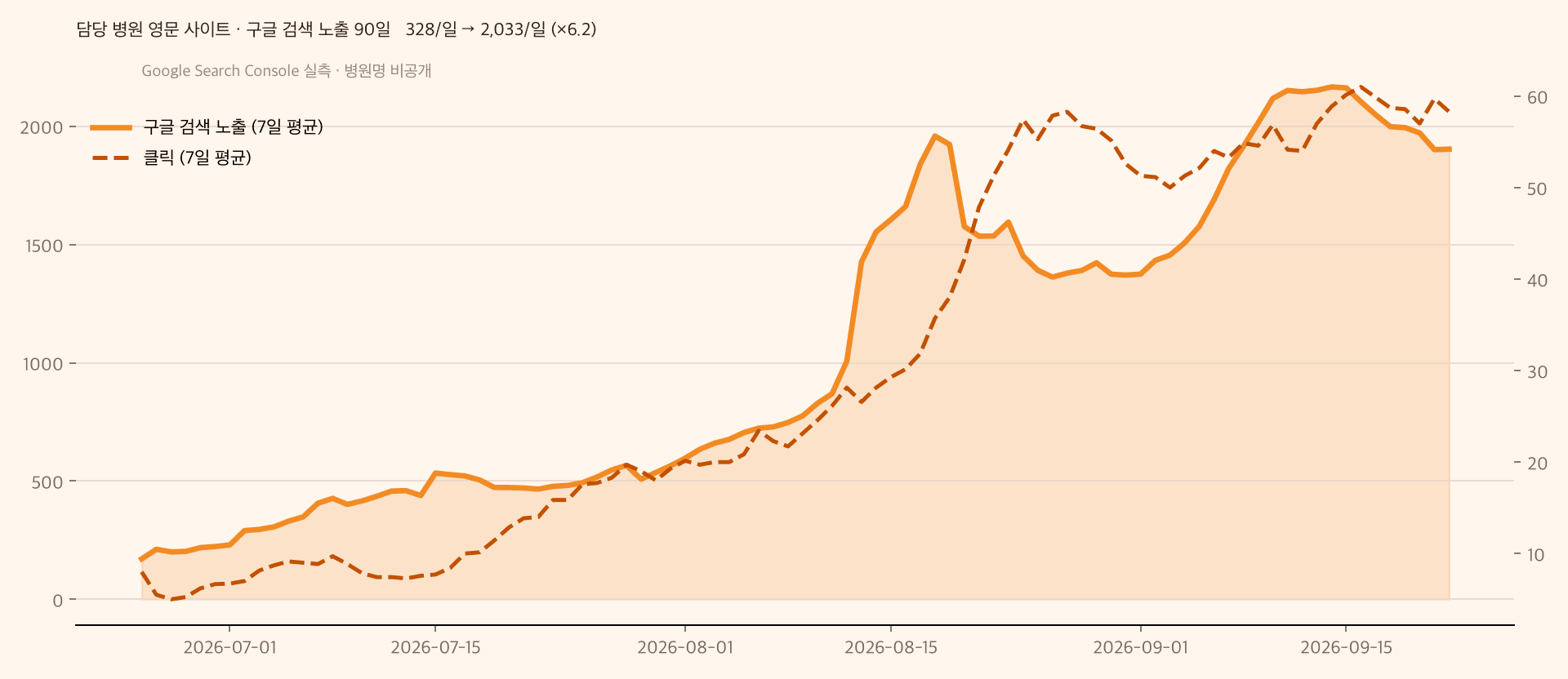
The model has to be judged the same way it bills: by revenue in a CRM. Our two documented engagements are dermatology clinics in Seoul — a market of two million international patients a year where clinic marketing is fought in five languages at once — and both were run on exactly the terms this page describes: nothing upfront, fee only on measured results.
Six signs your current retainer deserves the notice letter
Not every retainer should be canceled — but these patterns, pulled from the contracts owners show us on audit calls, usually mean the incentive design is working against you. One: the deliverables are described in hours and posts, not in rankings, citations, or revenue. Two: the monthly report is a PDF of activity with no live dashboard you can open yourself. Three: the contract auto-renews for another twelve months unless you object inside a narrow window. Four: the domain, content, or ad accounts are registered to the agency — see the checklist above. Five: attribution runs through the agency's own tracking layer rather than your CRM, so the vendor grades its own homework. Six: when you ask what happens if results don't come, the answer is a strategy revision — billed at the same rate.
Against each of those, the no-retainer test is one sentence: if the revenue does not materialize in your CRM, the agency does not get paid. Everything else on this page — the overlap exit, the ownership checklist, the four terms — follows from taking that sentence seriously. If you want to see how it maps onto your own numbers, the audit is free, takes 20 minutes, and works whether or not you ever sign: where your clinic shows up today across Google, ChatGPT, and Gemini, and what the assigned lines could plausibly produce. For the broader category context — facilitators, retainer shops, and asset builders side by side — start with the international patient marketing agency guide.
'/%3E%3C/svg%3E)