What is performance-based healthcare marketing?
Performance-based healthcare marketing ties the agency's fee to measured results instead of activity. The agency funds the work — content, infrastructure, tracking, response systems — and gets paid from what the work produces. In our version, the entire pricing model fits in one sentence: $0 upfront — the fee is 20% of revenue from the patient lines you assign to us, CRM-verified, with no per-patient counting.
The contrast is with the two structures most clinics have already bought. A retainer bills for effort: hours, reports, and ad management at a fixed monthly rate, results optional by design. Pay-per-lead bills for contacts: form fills and tracked calls, whether or not they ever become patients. A revenue-based model bills for neither — it earns only when collected revenue shows up in the clinic's own system, which makes the clinic's CRM, not the agency's dashboard, the referee.
If you searched for this page, you have probably paid at least one retainer that produced a handsome report and an unremarkable year. That experience is the market this model exists for — and it is fair to bring exactly that skepticism to the rest of this guide.
The retainer math: what clinics actually pay today
Published benchmarks put general healthcare marketing retainers at $2,500–10,000 a month, with comprehensive digital programs for a single-location practice typically landing at $3,000–8,000. Dental SEO alone runs $750–5,000 a month; multi-location groups pay $10,000–25,000; and in the most competitive fields — plastic surgery, med spas — retainers reach $8,000–20,000+. Ad spend is billed on top in nearly every arrangement.
Run the twelve-month math on the middle of that range: a $5,000 retainer is $60,000 a year, committed before the first result, often inside a 12-month term. The structural problem is not that retainer agencies are lazy — many aren't — it is that the pricing carries no information. A great month and a dead month invoice identically, so the agency's strongest incentive is to make the report look thorough, not to make the revenue move.
Against that anchor, the performance alternative reads simply: we charge nothing upfront, fund the build ourselves, and take 20% of the results — measured where you already measure everything else, in your CRM. If the engine produces nothing, the invoice is nothing. A full cost breakdown of the retainer market, with sources, is in what healthcare marketing agencies actually cost.
Why performance models earned their suspicion — and how the unit fixes it
Be honest about the category's reputation: performance pricing in healthcare has a rap sheet, and it was written by the pay-per-lead industry. Dentists have been publicly warned about vendors billing for no-show leads, recycling stale contact lists, and — the classic — routing the clinic's phone number through a tracking line so that existing patients' calls get counted as vendor-generated results. When the billable unit is a "lead," every one of those games pays.
The fix is not a nicer vendor; it is a different unit. Compare the structures:
| What you're comparing | Pay-per-lead | Retainer | Revenue-based (us) |
|---|---|---|---|
| Billable unit | A contact — whether or not it becomes a patient | A month of effort | Collected revenue in the lines you assign |
| Can the unit be gamed? | Yes — no-shows, recycled lists, tracking-number attribution | No, but it carries no result either | No — it exists only in your own CRM |
| Who verifies | The vendor's call logs | The agency's report | Your CRM — one monthly export |
| Agency incentive | Maximize countable contacts | Maximize apparent effort | Maximize revenue that actually collects |
| Your risk | Paying for noise | Paying for nothing | 20% of growth you can see |
Notice what "no per-patient counting" does in this design. It is not just a legal nicety — it removes the attribution fight entirely. Nobody argues about whether patient #47 came from the campaign, because nobody counts patients. The fee applies to a revenue pool — the patient lines you assigned — and the pool either grew in your CRM or it didn't.
Is a percentage fee even legal in healthcare?
The question every diligent owner should ask — so here is the framework, market by market, in plain language. The short version: paying for marketing services is not paying for patients, and the law in all three markets turns on keeping those two things structurally distinct. That is precisely why the model is worded the way it is.
United States. Federal anti-kickback law is aimed at inducements involving federal-program business — which is why this model is scoped to cash-pay and self-pay services only, with any federal-program business excluded from the fee base. Federal courts have also recently clarified the underlying distinction: payments to advertisers and marketers who exert no influence over medical decision-making are not payments for patient brokering — the line sits between building visibility a patient acts on freely, and steering individual patients to a particular provider. We build content assets; we never count, steer, or broker patients. Separately, several states (Florida, New York, California among them) maintain their own all-payer statutes around percentage arrangements — for clinics there, a flat-tier alternative (fixed monthly amounts stepped by results band) is available from day one.
United Kingdom. GMC rules prohibit doctors from paying for patient introductions and require conflicts of interest to be managed — which is why the fee here is expressed as a share of a revenue pool, never a per-patient amount, and why content is produced with GMC and ASA/CAP advertising standards in mind. Australia. The same pool-not-patient framing applies, and AHPRA's 2025 advertising guidelines govern every page we publish — no patient testimonials, no outcome claims.
Our standing position: have your healthcare attorney review the agreement before signing — we expect it, and the agreement is written to survive that review. An agency that discourages legal review is telling you something; listen to it.
The model in full: 20% of results, and the fine print
Here is everything, because a pricing page you have to book a call to see is a red flag in its own right. $0 upfront — our fee is 20% of revenue from the patient lines you assign to us, CRM-verified, with no per-patient counting. Content production, domains, hosting, daily rank and AI-citation tracking, and the 24/7 multilingual response line are funded by us. The only pass-through cost is international press placement, billed at exactly what the outlet charges, zero margin.
The exact base is designed around your practice during the free audit, before anything is signed — which lines you assign (domestic, international, or both) and what is excluded automatically: existing patients, revenue from channels you run yourself, patient lines we don't manage, and any federal-program business in the US. What we deliver against it is the engine described across this site: multilingual content assets, Google and AI-search visibility measured daily, and response coverage on the messengers patients actually use — the same system detailed in our healthcare AEO guide and multilingual patient acquisition.
| Term | How it works |
|---|---|
| Rate | 20% flat — five new patients or five hundred, the rate never moves |
| Base | Collected revenue from the patient lines you assign — designed with you during the free audit |
| Verification | Your CRM — one monthly export, no per-patient counting, no receipts |
| Upfront cost | $0 — no retainer, no setup fee; we fund the build |
| Exclusivity | None — keep your current agency, run your own ads |
| Cancellation | Anytime — no lock-in, no termination fee |
| Legal posture | Cash-pay/self-pay scope · flat-tier option for FL/NY/CA · attorney review welcomed |
Four terms always travel together: $0 upfront · non-exclusive · cancel anytime · monthly CRM settlement. The non-exclusivity is deliberate — a results-priced agency does not need a fence around the client. If someone else grows your other lines better, that costs us nothing; we are paid from the lines we grow. How the same structure reads without any percentage at all is covered in the no-retainer agency model.
Does it actually work? Two documented cases
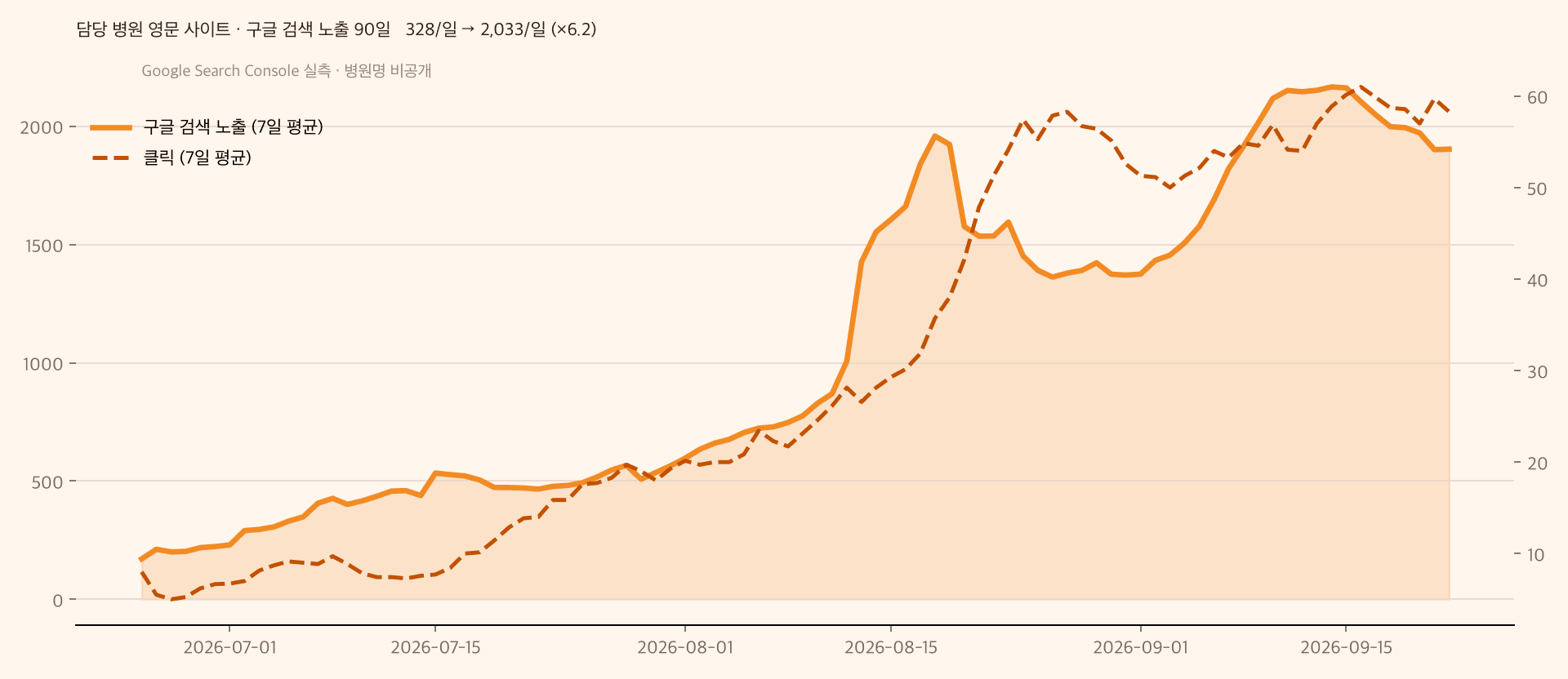
Performance pricing is only credible if the performer can show performance. Ours comes from Seoul — the world's most competitive medical tourism market, two million international patients a year, medical marketing fought in five languages at once. Two documented cases, both dermatology clinics, both measured the same way: foreign-patient revenue in the language lines we managed, read from the clinic's CRM.
※ Basis: internal CRM data from two Seoul dermatology clinics — foreign-patient revenue in the language lines we managed, versus the prior baseline. USD converted at ≈₩1,300/USD. These are our two documented cases; individual results vary with specialty, location, and competition. Clinic names withheld under NDA — full-screen walkthrough of live dashboards on the call, and a reference call can be arranged under NDA.
Over the first 60 days of those engagements we counted exactly one number — not how many patients anyone "sent," but the change in revenue across the assigned language lines. Both clinics were at +130% by day 60 (internal CRM data). That is the discipline the 20% buys: an agency with no reason to inflate anything, because the only number that pays is the one in your system.
What should you ask any performance-priced agency?
The label "performance-based" is doing heavy lifting across the industry, so test the structure underneath. First: what is the billable unit? If it is a lead, a call, or an appointment, every unit can be manufactured; if it is collected revenue in your own CRM, none can. Second: who verifies? The answer must be a system you own. Third: what happens in a zero month? A true performance model invoices nothing; a "performance" model with a minimum fee is a retainer wearing a costume.
Fourth: is there a lock-in? Results-priced agencies don't need one — 12-month terms exist to protect fee structures that can't protect themselves. Fifth: how does the agreement handle the law in my market? You want to hear cash-pay scoping, pool-based fees rather than per-patient amounts, and an open invitation for your attorney to review. Sixth: where is the performance history? Documented cases with a disclosed calculation basis — and an explanation when names are withheld — beat logo walls.
Our answers are on this page. The way to test them against your own practice is the free audit: where your clinic shows up today across Google, ChatGPT, and Gemini, and how the 20% model would map to your patient lines — free, no obligation, nothing signed.
'/%3E%3C/svg%3E)