The short answer: AI doesn't rank clinics — it cites answers
When a patient asks ChatGPT "which clinic should I book for this in my city," the engine doesn't consult a ranking. It assembles an answer from pages it can quote and attribute: pages that resolve the question directly, carry evidence, and are corroborated by independent signals — reviews, structured data, consistent business profiles, third-party mentions. Then it names the clinics those pages point to.
Most clinic websites cannot pass that test, through no fault of the medicine practiced inside. They are brochures — services, photos, credentials, a contact form. Nothing on them answers a question in a form an engine can lift. So the engine quotes someone else: a directory, a competitor's guide page, a portal. Your absence from AI answers is almost never about reputation; it is about quotability. That distinction matters because it makes the problem structural — and structural problems have checklists.
The urgency is arithmetic. Gartner projects traditional search engine volume to fall 25% by 2026 as users shift to AI assistants. The answer layer isn't a future channel; it is where a growing share of booking decisions already starts — in your city and, if you serve them, in the languages of patients researching from abroad.
Run this 10-minute self-test tonight
Before hiring anyone — us included — find out where you actually stand. No tools, no login, one evening. Ask the engines what your patients ask, not what an owner would ask: your clinic's name is the one query that proves nothing, because patients who know your name are already yours.
| Check | What to do | What a failing result looks like |
|---|---|---|
| 1. The money question | Ask ChatGPT and Gemini: "best-reviewed [your specialty] in [your city]" and "[treatment] in [your city] — which clinic?" | Competitors and directories are named; you are not |
| 2. The comparison question | Ask "[treatment A] vs [treatment B] — where should I get it in [city]?" | The engine explains the treatments but cites someone else's pages |
| 3. The AI Overview check | Google your top three treatments + city; look above the results | An AI Overview appears — and cites portals or competitors, not you |
| 4. The second-language check | Repeat check 1 in the languages your patient base speaks (Spanish, Arabic, Chinese…) | You don't exist at all outside English |
| 5. The quotability check | Open your own site: can any page answer checks 1–2 in its first screen? | Services lists and photos — no direct answers anywhere |
| 6. The corroboration check | Compare your Google Business Profile against your website: hours, services, links | Thin profile, stale reviews, mismatched details |
Score it honestly. Most owners who run this test for the first time fail four or more of the six — and the ones who pass usually got there deliberately. Either way, you now have something better than a vendor's pitch: a baseline.
The seven reasons clinics are invisible to AI — and the fix for each
Across the markets we track daily, nearly every AI-invisibility case reduces to some combination of these seven. They compound — which is also why fixing them compounds.
1. Brochure-site syndrome. The site describes the clinic instead of answering the patient. Fix: publish pages that each resolve one real patient question — directly, in the first screen, with evidence.
2. No question-shaped content. Patients ask in questions; engines retrieve in answers. If no page maps to "how much does X cost in [city]" or "is X safe after Y," there is nothing to cite. Fix: build the content from a query map of what patients actually ask, per treatment.
3. Missing machine-readable structure. No schema markup, no FAQ structure, tangled headings — engines can't confidently parse what the page asserts. Fix: schema and answer-first structure on every page. Necessary, though never sufficient on its own.
4. Weak corroboration. Engines need independent confirmation before naming a clinic: Google Business Profile completeness, review volume and recency, consistency between profile and site. Fix: usually the fastest win — align the profile, the site, and the review pipeline.
5. English-only coverage. The patient asking in Spanish, Arabic, or Chinese gets an answer assembled from pages in that language — and yours don't exist. Fix: native-language pages for the communities you actually serve; translation alone doesn't do it.
6. No third-party footprint. A clinic that exists only on its own domain gives engines a single, self-interested source. Fix: earn mentions where engines look — coverage, directories done properly, consistent citations of your data by others.
7. Nobody is measuring. Citations shift continuously, and what isn't tracked can't be fixed — or even noticed. Fix: daily citation tracking across engines. We run this across ChatGPT, Gemini, Perplexity, and Claude for every client, on 2,050 tracked keywords — the same substrate we track for medical tourism SEO rankings.
Notice what isn't on the list: reputation, clinical quality, years in practice. Engines can't see those until they are expressed as quotable, corroborated content. That is the entire discipline — the field now called AEO, which we cover in depth in our healthcare AEO guide.
What actually gets a clinic cited — and what doesn't
The fix list above has an underlying logic worth stating once, plainly: engines cite what they can verify, attribute, and quote. Everything that works serves one of those three verbs. Answer-first pages make you quotable. Schema and structure make you parseable. Reviews, profiles, and third-party mentions make you verifiable. The full method — how retrieval works, what engines weight, how we sequence the build — is published in our guides to AI search optimization for clinics and how AI decides which clinics to recommend. We publish the methodology because in this category, showing the work is the credential.
Equally important is what doesn't work. Stuffing "AI SEO" keywords into existing pages does nothing — engines retrieve meaning, not incantations. Schema on brochure content is a label on an empty box. And promises of assured placement in AI answers should end the conversation: no vendor controls what ChatGPT says, and the honest claim is measured visibility — tracked daily, shown live, never promised in advance.
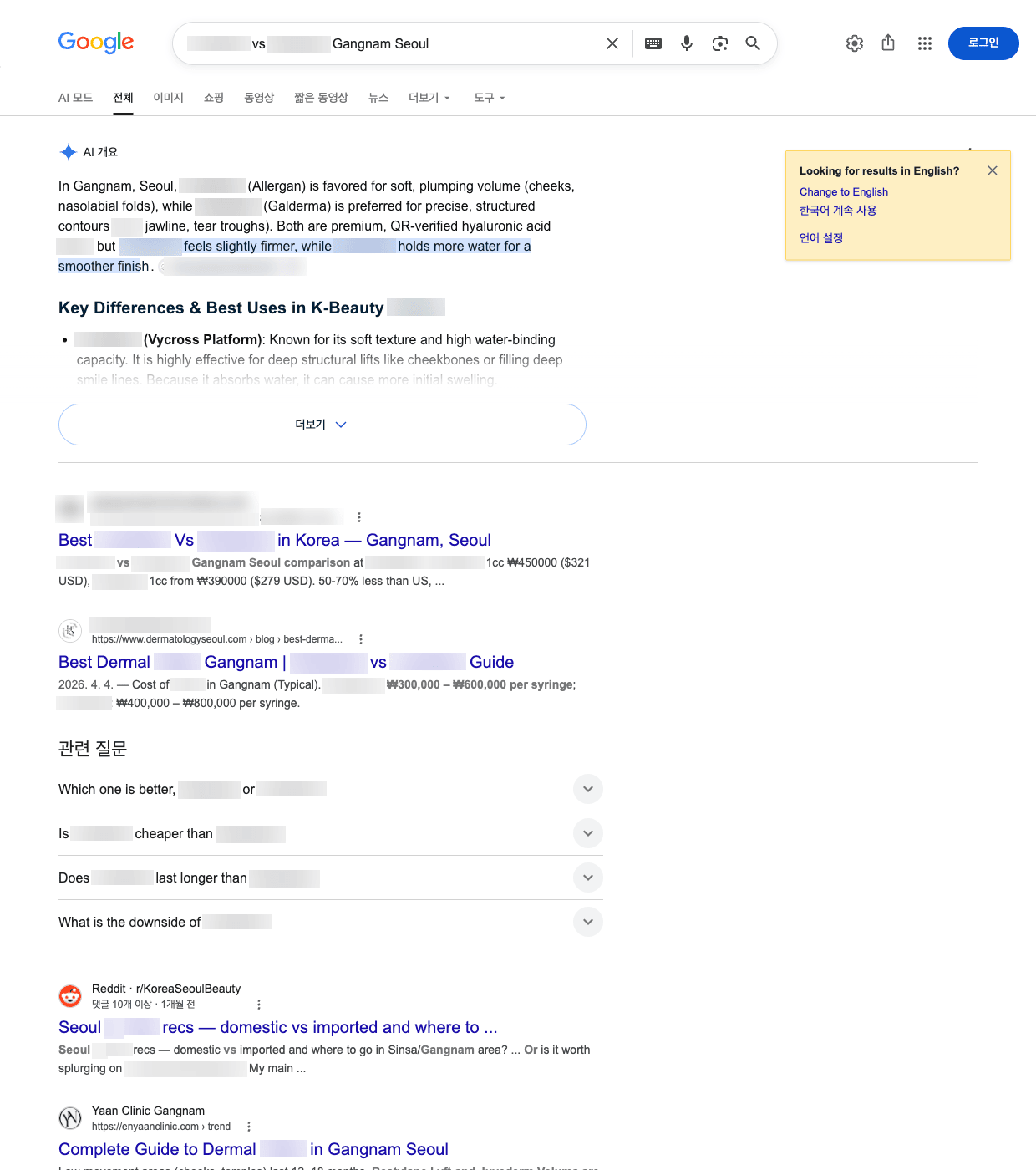
One more misconception worth retiring: "we rank #1 on Google, so we're covered." Ranking and citation are different tests run on the same material. A page can hold organic #1 on domain strength while offering nothing an engine can lift into an answer. The clinics that win both — like the pages in the screenshots below — built once for both tests.
Proof this is fixable: screens, not promises
We diagnose and fix AI invisibility for a living, in the hardest market there is: Seoul, where 2.01 million international patients a year are fought over in five languages at once. What follows is the evidence we show on every audit call — anonymized here, live and unblurred on the call.
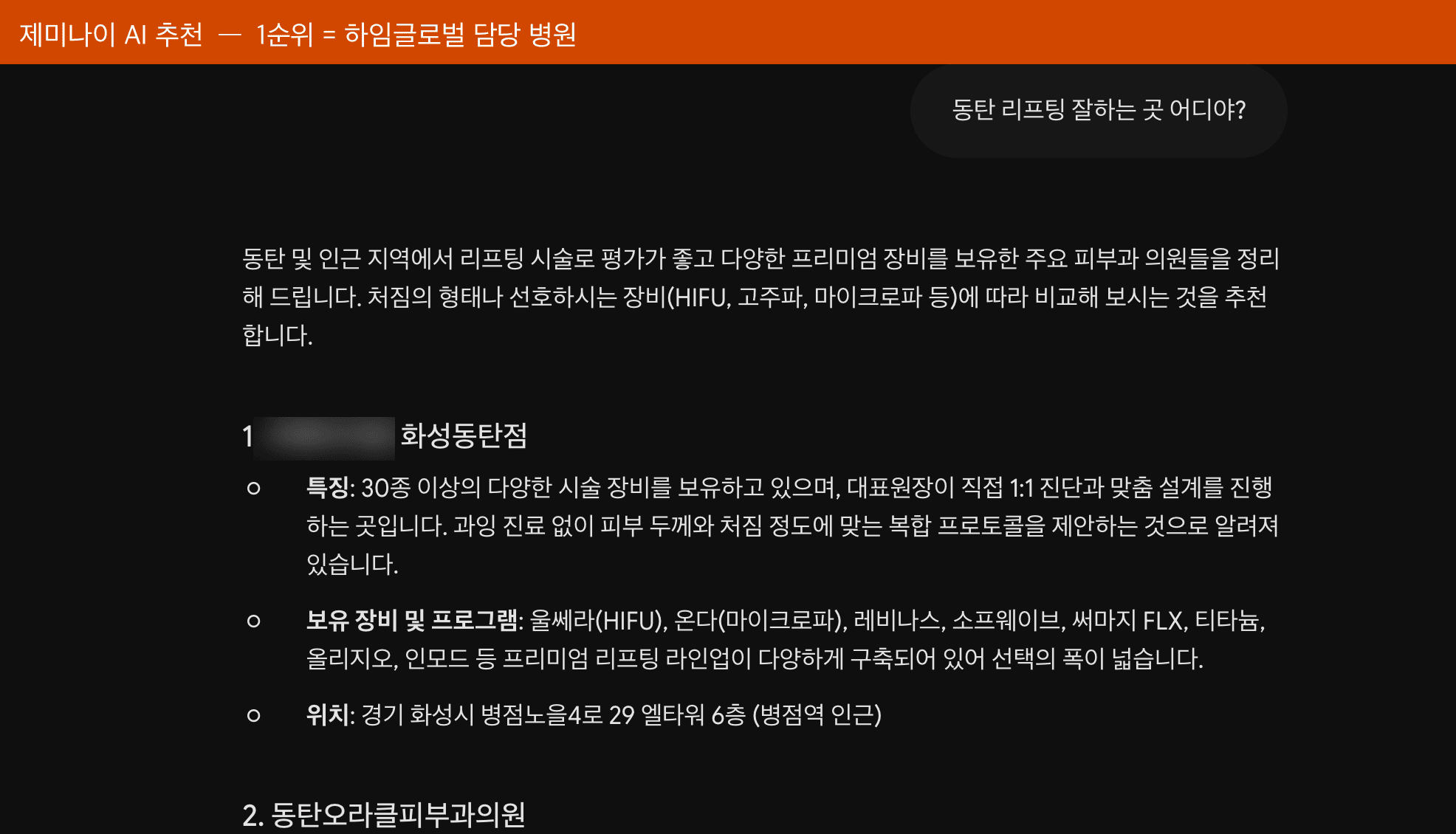
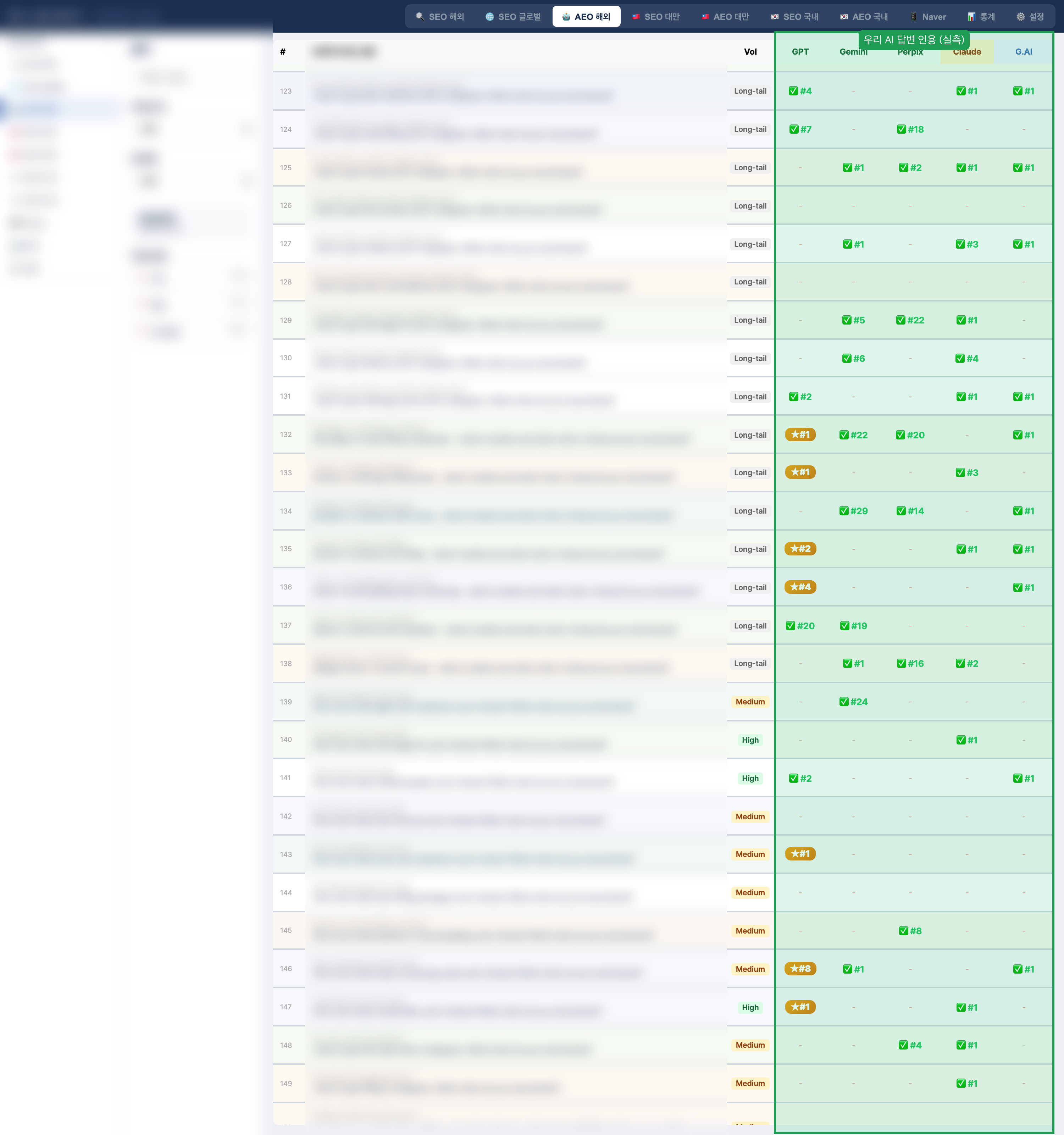
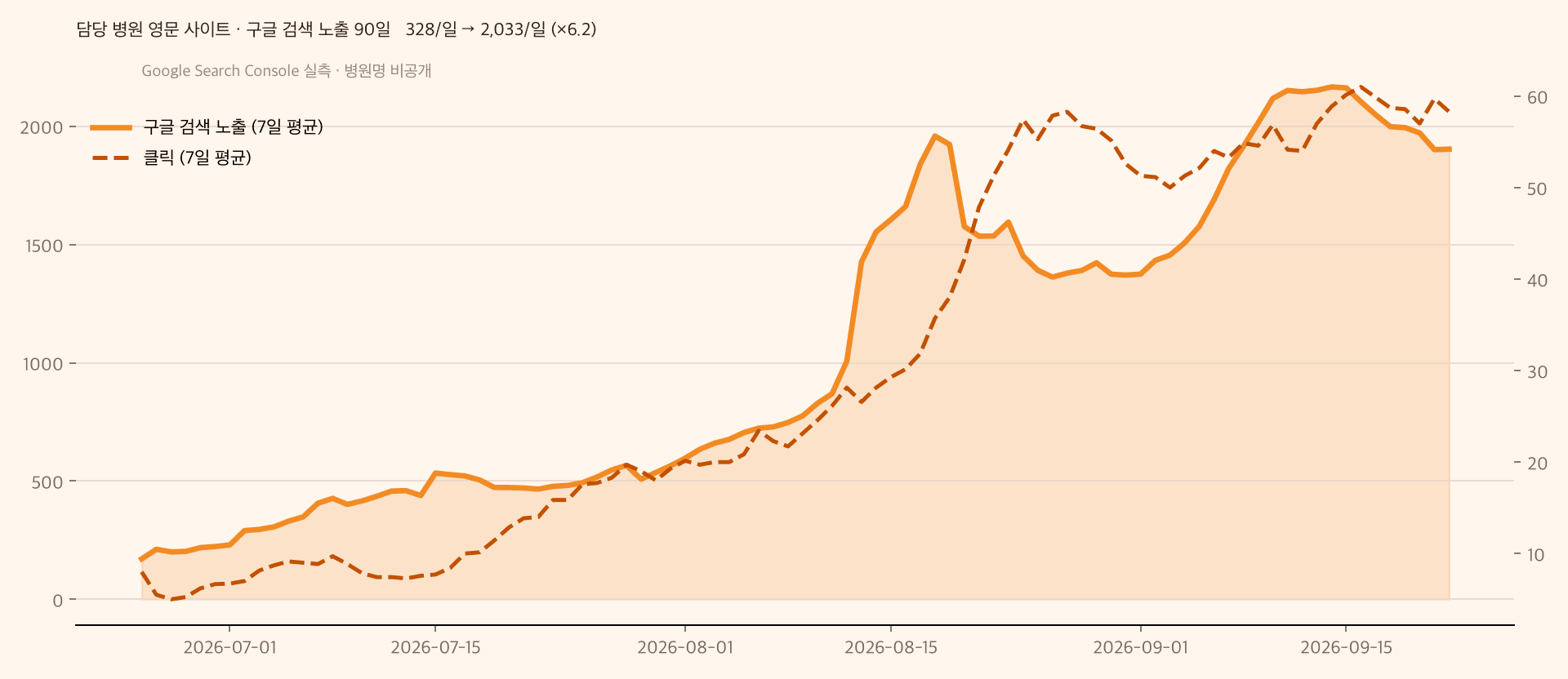
The commercial outcome behind those screens: two documented Seoul dermatology clinics reached +200% and +186% in foreign-patient revenue in the language lines we managed (internal CRM data, versus the prior baseline; individual results vary with specialty, location, and competition — clinic names withheld under NDA, full-screen dashboard walkthrough on the call).
The free AI-visibility audit: your self-test, done rigorously
The self-test above tells you whether there is a problem. The audit tells you how big it is, in whose favor, and whether it is worth fixing. On a 20-minute video call we walk through your clinic's live standing across ChatGPT, Gemini, and Google — the exact patient queries, the engines' verbatim answers, who gets cited instead of you, and the language markets that actually search for your specialty in your city. Free, no obligation, and honest by construction: a model that only earns on results has no incentive to sign a market it can't move, so if the numbers don't justify an engagement, the audit says so.
If they do, the terms are on the table before the call ends, because a pricing page you have to chase is a red flag in its own right. $0 upfront — our fee is 20% of revenue from the patient lines you assign to us, CRM-verified, with no per-patient counting. The exact base is designed around your practice during the audit — domestic lines, international lines, or both. Content, domains, hosting, daily rank and AI-citation tracking, and the 24/7 multilingual response line are funded by us. Four terms always travel with the 20%: $0 upfront · non-exclusive · cancel anytime · monthly CRM settlement. It is the same structure behind our performance-based healthcare marketing model — and this is not a payment for sending patients: we never count, steer, or broker individual patients, and your healthcare attorney is welcome to review the agreement. We expect it.
Compliance travels with the fix, market by market: content written to AHPRA's 2025 advertising guidelines in Australia, produced with GMC and ASA/CAP standards in mind in the UK, and following FTC endorsement rules in the US — because an AI-visible page that violates your advertising rules is a liability, not an asset.
'/%3E%3C/svg%3E)