Why Spanish SEO — and why is it dentists specifically?
Because the mismatch is largest in dentistry. Around 68 million people in the US speak Spanish — concentrated exactly where dental competition is fiercest: Miami, Houston, San Diego, Los Angeles, and the wider South, which alone accounts for roughly a third of the US inbound-patient market thanks to Latin-American proximity and bilingual workforces. Bilingual dental marketing is not a theory; “dentista en Houston”-class keywords are documented, commercially proven local search terms.
Yet walk through the websites of any ten practices in those metros and most publish in English only. That is the opportunity in one sentence: the patients are local, the demand is measurable, and the supply of native Spanish dental content is thin. For an individual practice, the Spanish side of local search is still winnable in a way the English side has not been for years — English dental keywords carry some of the highest costs-per-click of any industry (around $7.85 on average), while the Spanish equivalents remain comparatively uncontested.
And this is a domestic play, not a medical-tourism pitch. The Spanish-language line grows your base from your own zip code — the same engine can later add international upside, but nothing about it depends on a single patient crossing a border.
What does Spanish SEO actually involve — and why do translation widgets fail?
Most practices that “have Spanish” have one of three things: a Google-translate widget, a handful of machine-translated pages, or a bilingual staff member mentioned in the footer. None of these compete, because none of them start from what Spanish-speaking patients actually ask.
| What you're comparing | Translate widget | Machine-translated pages | Native Spanish content asset (us) |
|---|---|---|---|
| Search intent | None — English intent, Spanish words | English page structure, mirrored | Built from real Spanish queries and question patterns |
| Google indexing | Not indexable content you own | Indexed, rarely competitive | Dedicated pages, schema, hreflang — built to rank |
| AI citations | Invisible to AI answers | Rarely cited — thin, duplicated signals | Structured to be cited; tracked across 4 engines daily |
| Patient trust | Reads as an afterthought | Reads translated — and patients notice | Reads native — payment plans, insurance, fears addressed in Spanish |
| Compounding | Nothing accumulates | Little accumulates | Every page adds to a durable, owned asset base |
Native Spanish SEO means pages conceived in Spanish: the questions a first-generation patient asks about financing an implant, the way “emergency dentist” is actually phrased, the trust signals that matter to a family choosing a clinic for three generations at once. It also means the technical layer — clean URLs, hreflang, LocalBusiness and FAQ schema — so Google and AI engines can read the structure, not just the words. This is the same methodology we run across five languages and 7,700+ pages; Spanish is one of our standing production lines, not a subcontracted add-on.
Your next patients are asking ChatGPT — in Spanish
Search behavior follows the language people think in, and that now includes AI. A patient who asks ChatGPT, Gemini, or Google’s AI Overview “¿qué dentista me recomiendas cerca de mí?” gets an answer assembled from Spanish-language sources. English pages rarely make it into a Spanish answer — the engine cites what exists in the language of the question. If your practice has no native Spanish content, you are not losing the AI answer; you were never in it.
This is why Spanish SEO and AI-search optimization are one project, not two. The pages that rank for “dentista en Houston” are, when structured correctly, the same pages that get cited when the question moves into an AI chat window. We measure both sides daily — classic Google rankings across 2,050 tracked keywords, and citations across four AI engines — so the Spanish line reports the same way the English line does. How the citation mechanics work is a topic of its own: see AI search optimization for clinics and what a healthcare AEO agency does.
The same Spanish line defends against dental tourism
There is a second, quieter reason Spanish content pays for dentists: roughly 850,000 Americans a year are expected to travel abroad for dental work, a large share of it across the border to Mexico, where implants can run 60–80% cheaper. Spanish-speaking patients are disproportionately positioned to make that trip — they compare prices in Spanish, read Mexican clinic pages in Spanish, and decide before an English-only practice ever enters the conversation.
You will not beat Tijuana on price, and you should not try. What wins a meaningful slice back is being present in the research phase, in the patient’s language: honest pages on what border-crossing dentistry does and doesn’t include, continuity of care, warranty and follow-up realities, financing that changes the math. That content only works if it reads native — which is precisely the asset a Spanish SEO line builds. The full win-back playbook is its own guide: how US practices compete with dental tourism.
What should Spanish SEO for a dental practice cost?
Here is the honest market picture. Dental SEO retainers typically run $750–5,000 a month (most commonly $1,000–2,500), and comprehensive digital retainers $3,000–8,000 a month — billed whether results arrive or not. Adding a second language usually means adding budget, because agencies price by activity.
Our model prices by outcome instead. $0 upfront — our fee is 20% of collected revenue from the patient lines you assign to us, CRM-verified, with no per-patient counting. For most dental practices that means the Spanish-language line: we fund and build the content asset, run the tracking, and operate the 24/7 multilingual response coverage; you pay 20% of the revenue that materializes in your own practice-management system, and nothing else. The exact base is designed around your practice during the free audit, before anything is signed.
Four structural terms always travel with the 20%: $0 upfront · non-exclusive · cancel anytime · monthly CRM settlement. And the legal line, stated plainly: this is not a payment for sending patients. We never count, steer, or broker individual patients — the 20% is a flat marketing-services rate on a revenue pool, cash-pay and self-pay dentistry only, excluding any federal-program business. If your practice sits in a stricter state (FL, NY, CA), a flat-tier alternative is available. The broader model comparison lives at performance-based healthcare marketing.
| Term | How it works |
|---|---|
| Rate | 20% flat — five new patients or five hundred, the rate never moves |
| Base | Collected revenue from the patient lines you assign — designed with you during the free audit |
| Verification | Your CRM / practice-management system — one monthly export, no per-patient counting |
| Upfront cost | $0 — no retainer, no setup fee; content, hosting, and tracking funded by us |
| Exclusivity | None — keep your current agency, run your own ads |
| Cancellation | Anytime — no lock-in, no termination fee |
Why trust a Seoul team with your Spanish line?
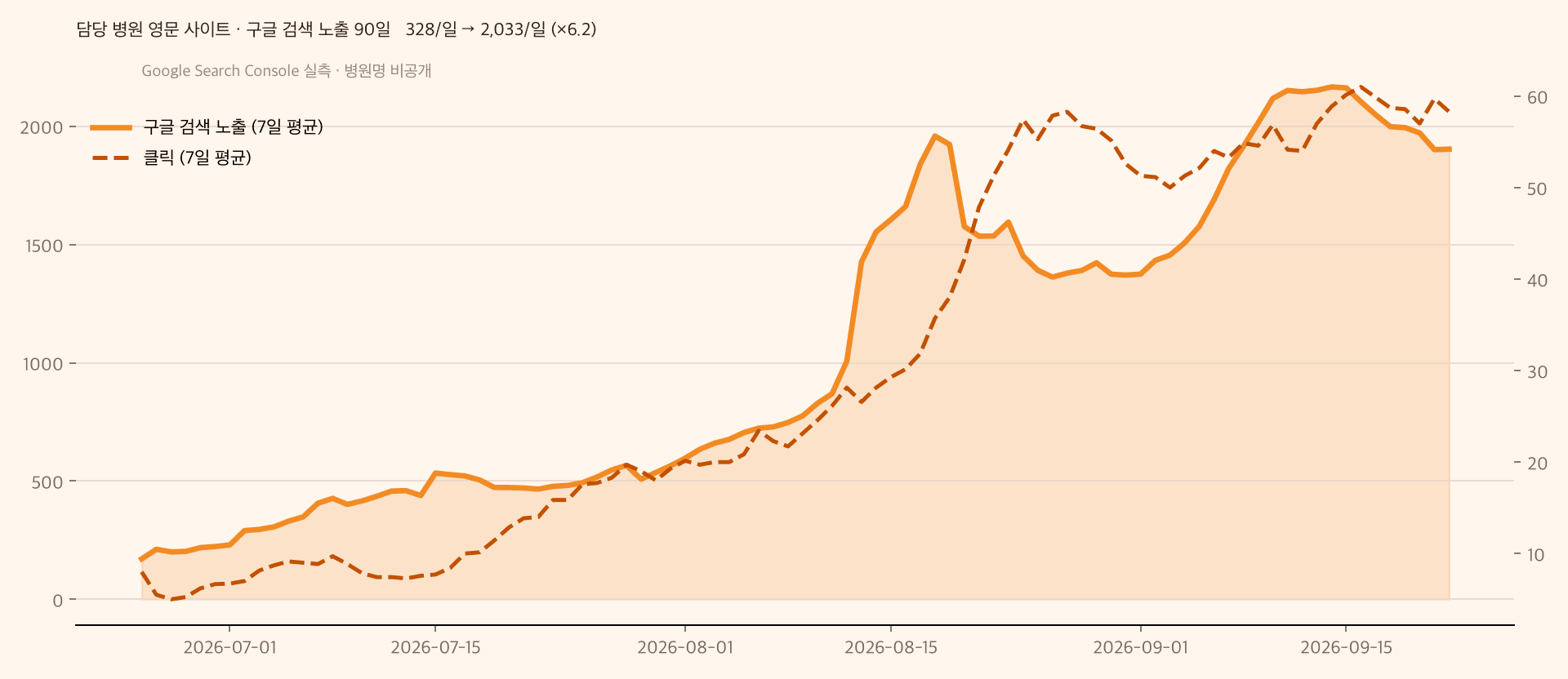
Because multilingual patient acquisition is our whole business, proven in the hardest market there is. Seoul receives two million international patients a year, and medical marketing there is fought in five languages simultaneously — Spanish among them. Ranking there, and being cited by AI there, is the credential we bring to a US zip code. Two documented cases, both dermatology clinics, both measured the same way your Spanish line would be:
How a Spanish line starts at your practice
It starts with a measurement, not a pitch. The free AI-visibility audit shows where your practice appears today when patients search and ask AI — in English and in Spanish: which competitors own “dentista” queries in your metro, what the AI engines answer when asked in Spanish, and where the gaps are. Twenty minutes, screen-shared, no obligation.
If the market is there — and in most Spanish-dense metros it is — we design the line together: which services lead (implants, orthodontics, family dentistry), which patient line you assign, and what counts in the base. Launch takes about 30 days from the audit; rankings typically start moving within weeks and consolidate over several months depending on competition. From day one you see the same dashboards we see. If it doesn’t produce revenue in your CRM, you don’t pay — that is the entire arrangement, and it is why we audit honestly before we start. Practices weighing a broader multilingual build can compare the approach at multilingual patient acquisition.
'/%3E%3C/svg%3E)